UI Coach Logo

Learn the principles behind the interface

UX laws, made visual

Explore all UX laws

From design to website

Turn your UI designs into live websites.

Build visually in Webflow, just like you design. Fine-tune typography, spacing, layout, and interactions until everything looks right, then publish your site live.

Explore Webflow

Latest from the design community

UX Collective · Dan Maccarone · Sep 9, 2026

What Shakespeare got right about AI

From ink and quill to glowing code: Shakespeare’s exploration of prophecy and equivocation, the art of speaking truths that mislead, anticipates the central challenge of our own relationship with artificial intelligence. Every warning we need about AI was written four hundred years ago. What witches, a forged letter,.

Read
Adactio · Sep 9, 2026

Native HTML and CSS Features That Replaced JavaScript · Ronalds Vilciņš

Modern HTML and CSS have gained a surprising number of features that cover interactions and layout problems we used to solve with custom scripts or libraries. JavaScript obviously isn’t going anywhere, and there are plenty of things that still require it, but in 2026 I find myself needing it less often for ordinary we.

Read

UX Planet · Nick Babich · Sep 9, 2026

GPT-6 Astra for Web Design

In this article, I’ll share the 4-step process I follow to craft a new web project with GPT-6. I’ll show you how to design a landing page… Continue reading on UX Planet »

Read

Smashing Magazine · hello@smashingmagazine.com (Carrie Webster) · Sep 9, 2026

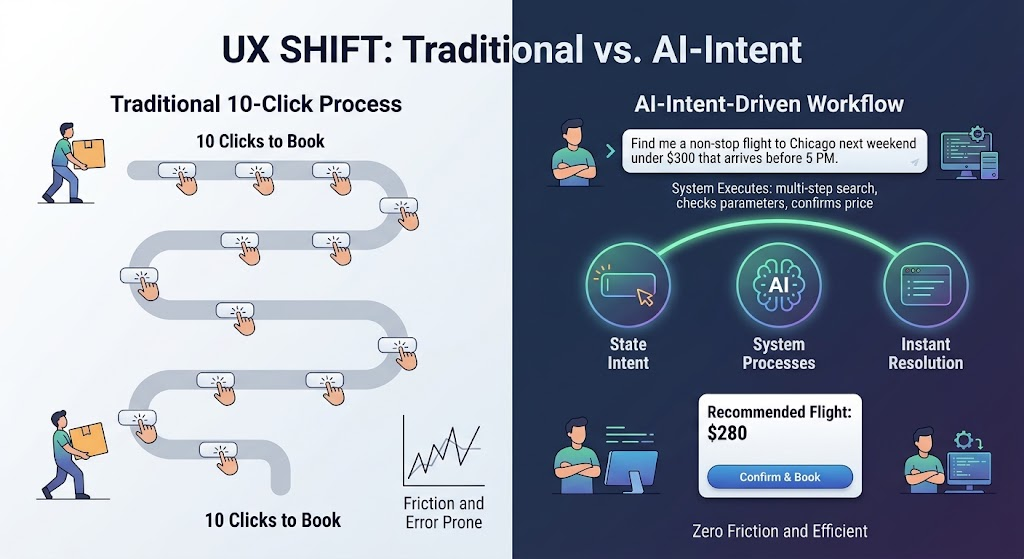
The Death Of The Button: Why The Best Interface Is No Interface

TThe web is evolving beyond menus, forms, and endless clicks toward experiences shaped around human intent. For UX designers, understanding this shift means re-evaluating their role, moving from designing visible interfaces to guiding transparent, intent-driven AI experiences.

Read

MeasuringU · Lucas Plabst, PhD • Jeff Sauro, PhD • Jim Lewis, PhD · Sep 9, 2026

Effectiveness of AI Moderators: A Literature Review

AI can replace research moderators. Maybe yes; maybe no. When we encounter interesting claims like that, we generally take the following approach: Define the claim. Assess evidence and the quality (focusing on peer-reviewed publications). Conduct our own experiments. Refine and revise our opinion of the claim. When it.

Read

Brad Frost · Sep 9, 2026

Our AI & Design Systems Course Is COMPLETE!

TL;DR: Our AI & Design Systems Course is complete; the price goes from $995 to $1,495 on September 30th. What the course includes - Over 20 hours of in-depth lessons across 200 videos covering core concepts, tools setup, techniques, and practical implementation of AI & design systems - Installable agent SKILLS files t.

Read

Adrian Roselli · Adrian Roselli · Sep 8, 2026

Support for `headers` Attribute

This post only covers the headers attribute in HTML tables (ARIA has no headers equivalent). My 2022 post Accessible Cart Tables? showed headers attribute support was poor. In my 2023 post Avoid Spanning Table Headers I didn’t use headers because I knew support was poor. For this post I merged…

Read

Eleken · Sep 8, 2026

18 UX Improvements That Move Product Metrics

See how small UX improvements to forms, navigation, and data tables lift usability, conversions, and retention; 18 practical fixes from real SaaS products.

Read

UX Collective · Takuma Kakehi · Sep 7, 2026

Tetris had to cheat to feel random

Nobody can see a probability distribution. You only ever see a sequence, and sequences are where human intuition falls apart. Continue reading on UX Collective »

Read

UX Planet · Nick Babich · Sep 7, 2026

GPT-6 Astra for UI Design

GPT-6 Astra is the latest and most powerful AI model from OpenAI. The model has already received a lot of praise for its capabilities. In… Continue reading on UX Planet »

Read

UX Collective · Fabricio Teixeira · Sep 6, 2026

AI canvas, Synthetic self, The prompt is the product

Weekly curated resources for designers — thinkers and makers. “AI coding agents are bringing some of that interaction model back. You can describe an outcome and let the agent decide which commands to run, which files to change and which tests to execute. You no longer have to operate the software step by step, but a.

Read